Here’s a conversation I have with small business owners all the time. “People like what we do. Our customers are happy. The ads get clicks and people visit the website. But hardly anyone enquires.” Nine times out of ten, the service isn’t the problem. The offer is.
An offer is the specific thing you’re asking someone to say yes to: what they get, how quickly, how easily and what happens if it doesn’t go to plan. “We do bookkeeping” is a service. “Your books cleaned up and BAS-ready in 10 business days, with a fixed price agreed before we start” is an offer. This post walks you through how to create an offer for your small business that people actually say yes to, using AI to do the heavy thinking with you. It works with ChatGPT, Claude, Grokbot or any AI assistant.
Why “book a free 15-minute chat” often isn’t enough
Most small business websites end with some version of “Contact us” or “Book a free chat”. There’s nothing wrong with a free chat. The problem is what it asks the customer to imagine. They have to guess what happens on the call, whether they’ll be sold to, what it might cost and whether you can even help with their situation. That’s a lot of uncertainty, so plenty of people quietly close the tab.
I won’t throw made-up conversion numbers at you. You probably already know whether your own website or ads have this gap.
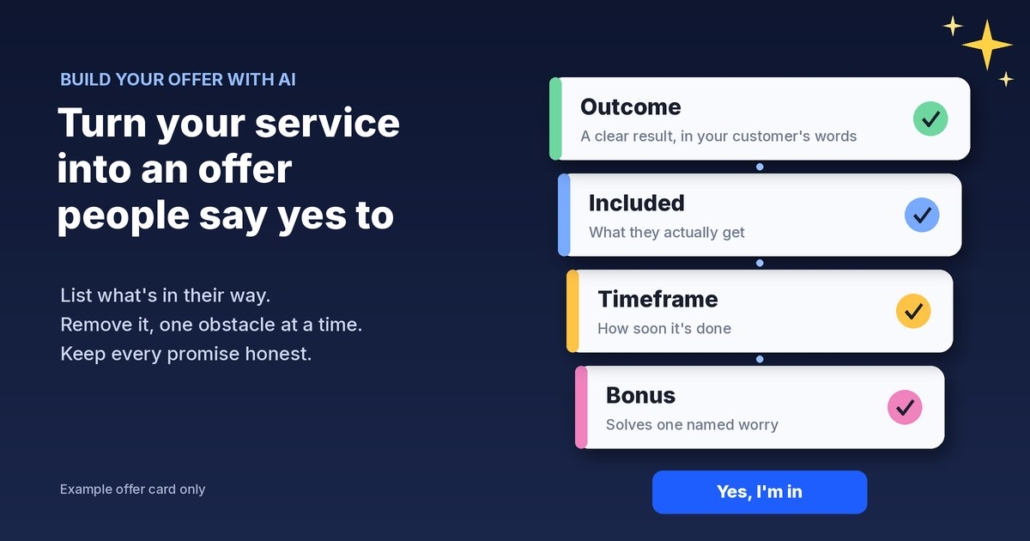
A strong offer closes that gap by answering four questions before the customer has to ask them:
- What will I get? (the outcome, not the activity)
- What’s included? (so it feels concrete)
- How long will it take? (so it feels close)
- What’s in it for me if I go first? (a bonus or an honest promise that lowers the risk)
A useful way to think about this comes from Alex Hormozi’s book $100M Offers. He describes value as the dream outcome and how likely the customer believes they’ll get it, divided by the time it takes and the effort involved. In plain English, people say yes when the result feels big, believable, quick and easy. Each step below pushes one of those levers.
Step 1: List what your customer wants and what’s in their way
Start with the customer, not your service. You want two lists: what they really want (in their words) and every obstacle that stops them getting it, including the ones that stop them buying from you.
Feed AI real customer language
AI is only as good as what you give it. Gather a page or two of real material:
- your Google reviews (and a few competitors’ public reviews)
- common questions from enquiry emails, phone calls or website chat
- reasons people gave for not going ahead with a quote
- notes from your best customer conversations
Strip out names and personal details, then paste it into your AI assistant with a prompt like this:
“I run [type of business] in [city]. Below are reviews, customer questions and reasons people didn’t go ahead. List: (1) the outcome customers really want, in their own words, (2) every obstacle, worry or excuse that stops them buying, grouped into time, effort, cost, trust and ‘not sure it’ll work for me’. Only use what’s in the text. Don’t invent anything.”
That last line matters. You want patterns from real customers, not generic marketing ideas.
An example
Example only: a mobile dog groomer might find customers want “a clean, calm dog without the drive and the half-day wait”. The obstacles might be “my dog gets anxious”, “I never know when you’ll turn up”, “I’m worried about the price creeping up” and “I’ve been let down by a groomer before”.
Step 2: Turn each obstacle into part of the offer
This is where an ordinary service becomes an offer. For every obstacle on your list, ask: what could we include, change or promise so this worry goes away? Then ask AI to help you brainstorm, using the “how to get [outcome] without [obstacle]” format:
“For each obstacle below, suggest two or three practical ways my business could remove it. Write each as ‘How to get [outcome] without [obstacle]’. Keep the ideas realistic for a small team, and flag anything that would cost a lot to deliver.”
Sort the ideas into three buckets
- What’s included. The concrete pieces: a checklist, a setup session, a follow-up visit, a written plan. Example: “a quiet first visit to meet your dog before the first groom”.
- How fast. Anything that shortens the wait for the result. Example: “a confirmed arrival window sent the night before”.
- How easy. Anything that cuts the effort on the customer’s side. Example: “we bring water and power, so you don’t have to do anything”.
Then trim. Keep what matters a lot to the customer and costs you little to deliver. An offer you can’t deliver consistently is worse than none.
Use bonuses that solve a named problem
A good bonus isn’t a random freebie. It removes a specific obstacle from your list. If customers worry about what happens after the job, a short “first 30 days” checklist is a bonus with a purpose. If they worry about price, a fixed quote agreed in writing before you start is worth more to them than a discount.
Step 3: Name it clearly and keep any guarantee honest
Your offer needs a name that tells people what they get; clear beats clever. A simple pattern is: who it’s for + the result + the timeframe + a container word like “Plan”, “Setup”, “Check” or “Sprint”.
Ask AI for options:
“Here’s my offer: [paste the included items, timeframe and bonuses]. Suggest 10 plain-English names for it using who it’s for, the result and the timeframe. No hype words, no exclamation marks, Australian spelling.”
Examples only: “The Calm First Groom Visit”, “Books BAS-Ready in 10 Days”, “The 2-Week Website Enquiry Fix”. Pick one a customer would understand straight away.
Guarantees: only promise what you control
A guarantee can make an offer much easier to say yes to, but in Australia it has to be honest. The ACCC’s guidance on false or misleading claims says a business making a claim about the future must have reasonable grounds for it at the time, and that fine print mustn’t contradict the overall message. The same page warns about things offered “free” when conditions apply. So:
- Promise things you control, such as timeframes, what’s included, how you’ll communicate and redoing work that isn’t right.
- Avoid promising results you don’t control, like “double your sales” or “guaranteed leads”.
- If something is free, make sure it really is, or state the conditions clearly up front.
- Never use fake reviews, invented testimonials or results you can’t back up.
Ask your AI assistant to check your draft: “Read this offer as a cautious Australian customer and as the ACCC. Point out anything that could be misleading, vague or over-promised.” It’s not legal advice, but it’s a good first filter. If you’re unsure, get proper advice.
Step 4: Write the offer in one page
Before it goes anywhere near your website, get the whole offer onto one page. AI is great at this. Give it everything from steps 1 to 3 and ask for:
- a one-sentence headline stating the outcome and timeframe
- who it’s for (and who it isn’t for)
- what’s included, as a short list
- how it works, in three steps
- the bonus and the honest promise
- one clear next step (book, call or reply)
Read it out loud and rewrite any line that sounds like a brochure. If you write quotes regularly, this page also makes a great intro section. My post on how to write quotes faster with AI shows how to reuse it.
Step 5: Test it on a landing page or a few past customers first
Don’t rebuild your whole website around a new offer on day one. Test it small.
Start with people who already know you
Past customers are the easiest, kindest test audience you’ve got. Send the one-page offer to a handful of them with a short, personal note asking what they think, and whether they’d have said yes when they first came to you. If you haven’t spoken to past customers in a while, my guide on how to win back past customers with AI covers how to reach out without being pushy.
Then put it on one page with one action
Next, put the offer on a simple landing page with one call to action and an inline form that works on a phone. Send a little traffic to it from an email, a social post or a modest ad, and compare enquiries with your old “contact us” approach. Note the questions people ask; they tell you what to add next.
Once a month, paste new enquiries and objections into your AI assistant and ask: “What’s still stopping people saying yes? Suggest one change to the offer.”
What to do this week
- Monday: gather your reviews, common questions and reasons people didn’t go ahead into one document.
- Tuesday: paste it into your AI assistant and get your “what they want” and “what’s in the way” lists.
- Wednesday: turn each obstacle into something included, faster or easier, then trim the list.
- Thursday: name the offer, write the one-page version and run the honesty check.
- Friday: send it to three to five past customers and ask for their honest reaction.
FAQ
What’s the difference between a service and an offer?
A service is what you do. An offer is the specific package you’re asking someone to say yes to: the outcome, what’s included, the timeframe, any bonus and your promise. Two businesses can deliver the same service, and the one with the clearer offer usually gets the enquiry.
Can I offer a money-back guarantee?
You can, as long as it’s genuine, clearly explained and you’ll honour it. Keep it to things you control, and make sure the conditions don’t contradict the headline. The ACCC’s guidance on false or misleading claims is worth reading before you publish one.
Which AI tool should I use to build my offer?
Any good AI assistant will do, including ChatGPT, Claude or Grokbot. What matters most is giving it real customer language and telling it not to invent anything.
Want a second set of eyes on your offer?
Book a free AI audit. We’ll look at how enquiries come into your business, where people drop off and how AI can help you tighten your offer and follow up faster. You’ll leave with practical next steps, whether or not we work together.