If you’ve searched for an AI consultant in Brisbane lately, you’ve probably noticed something. Everyone promises to “transform your business with AI”, and almost nobody tells you what they’ll actually do on Monday morning, or what it’ll cost. That makes it hard to know whether you need one at all, and hard to compare the ones you find.
I set up AI for small businesses, so I’ve seen this from both sides. In this post I’ll explain the types of AI help on offer, what a good first engagement looks like, the questions to ask before you hire anyone, the red flags to watch for, and how pricing usually works. By the end you should be able to sit down with any consultant, me included, and work out quickly whether they’re the right fit.
Why so many business owners are stuck
You’re not the only one who isn’t sure where AI fits. The National AI Centre’s AI adoption insights for December 2025 to February 2026 found that among businesses not using AI, around 65% pointed to trust and wanting to keep human control, 54% said it wasn’t relevant to their business, and 19% said they didn’t know how to start.
A good AI consultant should help with all three. They should show you where it’s relevant to your business, set it up so you stay in control, and give you a clear first step. If you’d like to try that first step yourself, my post on where to start with AI in a small business walks you through a 30-minute audit you can do today.
The three types of AI help
Most AI consulting falls into one of three buckets. Knowing which one you need saves you paying for the wrong thing.
1. Training
Someone teaches you and your team how to use AI assistants such as ChatGPT, Claude or Grokbot for your everyday work: writing emails, summarising documents, drafting quotes and so on. This suits you if your team is keen but unsure, and you’re happy to do the work yourselves once you know how.
2. Setup (done with you)
The consultant works alongside you to build specific AI workflows into how you already operate. For example, an instant reply to new enquiries, a follow-up sequence for quotes, or a weekly business review. You learn as it’s built, and you own it at the end. This suits most small businesses because it gets real work off your plate without locking you in.
3. Done for you
The consultant builds and runs the AI workflows, and often maintains them month to month. This suits you if you have no time at all and would rather pay to have it handled. The trade-off is that you rely on them, so it matters even more that you understand what’s been built and who controls it.
What a good first engagement looks like
When I looked at what people say about AI consultants in Brisbane, in reviews and on their own websites, the same themes kept coming up. People want practical quick wins rather than a big quote with vague promises. They want someone who learns the business first. And they want something their team will actually use.
So a good first engagement is small, specific and measurable. It usually looks like this:
Step 1: A short look at how you work
Before anyone talks tools, they should ask about your week. Where do enquiries come in? What happens after you send a quote? What admin eats your evenings? This should take a short call, not a month-long “discovery phase”.
Step 2: One or two quick wins
From that conversation, they pick one or two jobs where AI can save time with low risk. Good candidates are repeatable, text-heavy and easy to check, such as replying to enquiries, following up quotes, sorting your inbox or asking for reviews.
Step 3: Build, test, then switch on
The workflow gets built, tested on real examples, and only then switched on. In the early days the AI should draft and a person should approve. If you’re worried about trust and data, my post on whether AI is safe for small business covers the rules I use.
Step 4: Check it’s working
After a week or two, you look at what’s changed. Are replies going out faster? Are quotes being followed up? Is the team actually using it? If not, it gets fixed or dropped before you spend more.
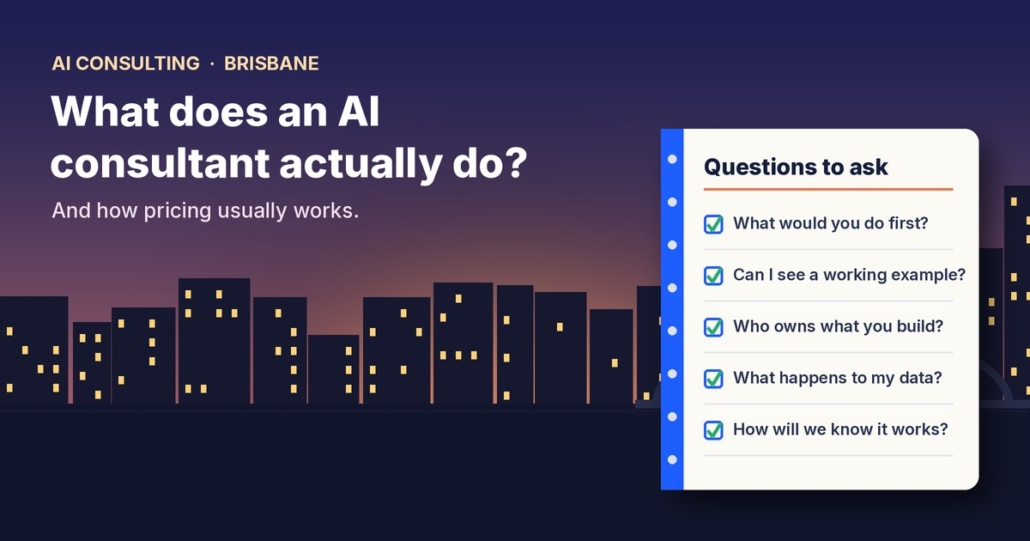
Questions to ask before you hire an AI consultant
Here are the questions I’d ask if I were hiring one. A good consultant will be happy to answer every one of them in plain English.
- What would you do first in my business, and why? You want a specific answer tied to your work, not a general pitch.
- Can you show me a working example? Ideally something similar to your type of business. A live demo beats a slide deck.
- Who owns what you build? You should own your prompts, workflows and accounts, so you can keep using them if you part ways.
- What happens to my data? Ask which tools and accounts will be used, what data goes into them, and what settings protect it.
- How will we know it’s working? Agree up front what you’ll look at, such as time saved, replies sent or quotes followed up.
- How will my team learn to use it? If nobody uses it, it’s wasted money. Training should be part of the plan.
- What’s the next step if the first one works, and what if it doesn’t? You want a clear path, not an open-ended commitment.
Red flags to watch for
Not every red flag means someone’s dodgy, but each one is worth a closer look.
Guaranteed results
Nobody can honestly guarantee “double your leads” or “save 20 hours a week” before they’ve seen how you work. Be wary of big promises with no detail behind them.
A big quote before they understand your business
If you’re handed a large proposal after a five-minute chat, they’re selling a package, not solving your problem.
Jargon instead of answers
If you ask a simple question and get a word salad back, that’s how the whole project will feel. Good consultants explain things in your language.
Lock-in
Watch for setups where everything lives in their accounts, uses their own tools you can’t access, or stops working the day you stop paying. You should be able to walk away with what you paid for.
AI that sends things without a human
Early on, anything that goes to a customer should be checked by a person. A consultant who wants AI emailing your clients unsupervised from day one is taking risks with your reputation.
How AI consulting pricing usually works
I’m not going to quote you an “average price” for AI consulting in Brisbane, because there isn’t a reliable one, and any number would depend heavily on what’s being built. What I can do is explain the common pricing models so you know what you’re comparing.
Hourly or daily rate
Common for training and advice. It’s flexible, but the total can be hard to predict, so ask for an estimate of hours and a cap.
Fixed-price project
A set price for a defined piece of work, such as building and testing one workflow. This is easier to budget for. Make sure the scope is written down, including what “done” means.
Monthly retainer
An ongoing fee for maintaining, improving and adding workflows. This suits done-for-you setups. Check what’s included each month and how much notice you need to give to stop.
Free audit or first call
Many consultants, me included, offer a short free audit to see whether there’s a fit. Use it to judge how well they listen, and whether they come back with something specific to your business.
Whatever the model, the tools themselves are a separate cost. AI assistants and any software you connect them to usually have their own subscription fees, so ask your consultant to list those separately.
Can you do it yourself instead?
Often, yes, especially for your first workflow. If you’re comfortable trying things, you can start with free templates and an AI assistant you already pay for. My free Steal My AI Agents pack has six ready-to-use agents, including Instant Lead Reply, 7-Day Follow-Up and Inbox Triage, and works with ChatGPT, Claude, Grokbot or any AI assistant. A consultant becomes worth it when you’d rather not spend your own hours setting it up, or when you want several workflows connected properly.
What to do this week
- Write down three jobs that eat your time every week.
- Decide which type of help you need: training, done with you, or done for you.
- Pick two or three consultants and ask each one the questions above.
- Book a short free call and see who comes back with a specific first step for your business.
- Start with one quick win, check it after a fortnight, and only then expand.
FAQ
What does an AI consultant actually do?
An AI consultant works out where AI can save time in your business, then trains your team, builds the workflows with you, or builds and runs them for you. A good one starts with how you work, not with a particular tool.
How much does an AI consultant cost in Brisbane?
It depends on the type of help and the scope. Common models are hourly or daily rates, fixed-price projects and monthly retainers, and many consultants offer a free first call or audit. Ask for a written scope and list any software subscriptions separately.
Will AI work for my industry?
Most small businesses have repeatable, text-heavy jobs such as enquiries, quotes, follow-ups, emails and reviews, and those are where AI usually helps first. The best way to find out is to ask a consultant to show you a working example close to your type of business.
How long until we see a result?
That depends on the job, and no one should guarantee a timeline before seeing how you work. A sensible first engagement focuses on one small workflow you can test and check within a couple of weeks.
Do I need a tech team to work with an AI consultant?
No. Most small-business AI workflows run inside an AI assistant and the tools you already use. You need someone who knows how the work is done, not a developer.
Want a specific first step for your business?
Book a free 15-minute AI workflow audit. We’ll look at where enquiries, follow-ups and admin are slowing you down and show you where AI can help first. No tech team needed and no obligation.